

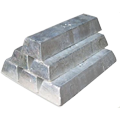
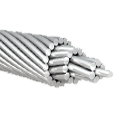
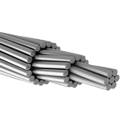
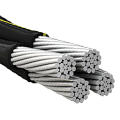
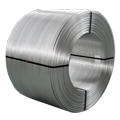
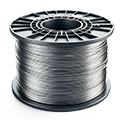
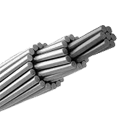


AAC (All Aluminum Conductor) is an aerial conductor made from stranded aluminum wires of 1350 alloy without any coating. These conductors are widely used in low and medium voltage power transmission and distribution lines due to their lightweight nature, high strength, good electrical conductivity, and resistance to corrosion.
Features of AAC:
- Lightweight: AAC conductors, compared to copper conductors of similar weight, offer higher electrical conductivity.
- High Strength: AAC conductors exhibit high tensile strength .
- Good Electrical Conductivity: Aluminum has good electrical conductivity, allowing AAC conductors to efficiently transmit electrical currents.
- Corrosion Resistance: The natural oxide layer formed on aluminum enhances its resistance to corrosion.
- Cost-effective: AAC conductors are more cost-effective compared to copper conductors.
Applications of AAC:
- Power Transmission Lines: AAC conductors are extensively used in both strong and weak power transmission lines.
- Power Distribution Lines: These conductors are utilized in urban and rural power distribution networks.
- Overhead Networks: AAC conductors are suitable for electricity transmission in difficult terrains and mountainous regions.
- Aerial Wiring: They are used for aerial wiring in buildings and industrial installations.
Advantages of Using AAC:
- Cost Reduction: AAC conductors significantly reduce construction and maintenance costs due to their lightweight and affordability.
- Reduction of Electrical Losses: High electrical conductivity of AAC conductors minimizes electrical losses in power lines.
- Network Stability Improvement: The high strength of AAC conductors enhances the stability of power networks against wind and storms.
- Environmental Friendliness: AAC conductors are recyclable, making them an environmentally friendly option.
Disadvantages of Using AAC:
- Lower Flexural Strength: AAC conductors have lower flexural strength compared to copper conductors, making them more prone to breakage when bent.
- Difficult Connections: Due to the natural oxide layer, connecting AAC conductors is more challenging than connecting copper conductors.
- Temperature Sensitivity: AAC conductors are more sensitive to temperature fluctuations, which can lead to decreased electrical conductivity when heated.
Choosing the appropriate type of conductor for power lines depends on various factors such as line voltage, length, environmental conditions, and project budget. In many cases, AAC conductors are a cost-effective and suitable choice for both strong and weak power transmission and distribution lines due to their multiple advantages.
standard:
DIN 48201-5
| Area | No. & Dia. of Wire | Approx. Overall Dia. |
Approx. Weight |
Nominal Breaking Load |
Max. DC Resistance at 20°C |
|
| Nominal | Actual | |||||
| mm2 | mm2 | No./mm | mm | kg/km | kN | Ω/km |
| 16 | 15.9 | 7/1.70 | 5.10 | 43.0 | 2.8 | 1.8022 |
| 25 | 24.3 | 7/2.10 | 6.30 | 66.0 | 4.2 | 1.1810 |
| 35 | 34.4 | 7/2.50 | 7.50 | 94.0 | 5.8 | 0.8333 |
| 50 | 49.5 | 7/3.00 | 9.00 | 135.0 | 7.9 | 0.5787 |
| 50 | 48.4 | 19/1.80 | 9.00 | 133.0 | 8.5 | 0.5951 |
| 70 | 65.8 | 19/2.10 | 10.50 | 181.0 | 11.3 | 0.4372 |
| 95 | 93.3 | 19/2.50 | 12.50 | 256.0 | 15.7 | 0.3085 |
| 120 | 117.0 | 19/2.80 | 14.00 | 322.0 | 18.8 | 0.2459 |
| 150 | 147.1 | 37/2.25 | 15.80 | 406.0 | 25.3 | 0.1960 |
| 185 | 181.6 | 37/2.50 | 17.50 | 500.0 | 30.5 | 0.1588 |
| 240 | 242.5 | 61/2.25 | 20.30 | 670.0 | 39.5 | 0.1191 |
| 300 | 299.4 | 61/2.50 | 22.50 | 827.0 | 47.7 | 0.0965 |
| 400 | 400.1 | 61/2.89 | 26.00 | 1104.0 | 60.9 | 0.0722 |
| 500 | 499.8 | 61/3.23 | 29.10 | 1379.0 | 74.7 | 0.0578 |
| 625 | 626.2 | 91/2.96 | 32.60 | 1732.0 | 95.3 | 0.0462 |
| 800 | 802.1 | 91/3.35 | 36.90 | 2218.0 | 118.4 | 0.0360 |
| 1000 | 999.7 | 91/3.74 | 41.10 | 2767.0 | 145.8 | 0.0289 |
Reviews
There are no reviews yet.