
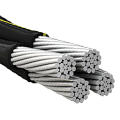
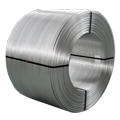
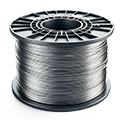
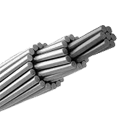


Premium AAC Conductors (All Aluminum Conductor 1350-H19)
All Aluminium Conductor / AAC Conductor 70 / AAC 70mm²
The Proven Standard for Reliable Overhead Distribution
Our All Aluminum Conductors (AAC) are the definitive solution for low and medium-voltage overhead power distribution and transmission. Engineered from high-purity, EC-grade 1350-H19 aluminum alloy (99.5% minimum purity), these conductors provide an optimal, cost-effective blend of electrical conductivity, low weight, and exceptional corrosion resistance.
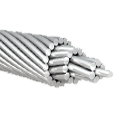
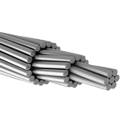
AAC consists of one or more strands of hard-drawn 1350 aluminum, helically stranded. As a homogenous conductor, it is the industry standard for urban, rural, and industrial distribution networks where high tensile strength is not the primary limiting factor.
Contact our engineering team for technical specifications or request a quote today.
Core Features & Validated Benefits
⚡ Superior Electrical Conductivity
Our AAC conductors are manufactured from 1350-H19 alloy, which is specifically treated to optimize electrical properties.
- Validated Data: This alloy provides a high conductivity of 61.2% IACS (International Annealed Copper Standard).
- Weight Advantage: On a per-weight basis, aluminum offers twice the electrical conductivity of copper. This makes AAC a highly efficient and economical choice for moving power.
🏋️ Excellent Strength-to-Weight Ratio
While copper is heavier, AAC’s lightweight nature is a primary engineering advantage.
- Reduced Tower Load: The lighter conductor weight (approximately 50% lighter than a copper conductor of equivalent resistance) reduces the mechanical load on poles, towers, and support structures.
- Installation & Cost Savings: This reduced weight simplifies handling, speeds up installation, and lowers transportation costs, directly reducing overall project expenses.
🛡️ Exceptional Corrosion Resistance
AAC is highly resistant to atmospheric corrosion, making it ideal for long-term outdoor installations.
- Technical Mechanism: Aluminum naturally forms a tough, self-healing aluminum oxide ($Al_2O_3$) layer on its surface. This inert, passivating film prevents further oxidation and degradation, ensuring a long, maintenance-free service life, especially in polluted industrial or coastal environments.
💰 Unmatched Cost-Effectiveness
AAC delivers significant economic advantages over other conductor types.
- Lower Material Cost: Aluminum is a more abundant and cost-stable commodity compared to copper, providing substantial upfront savings.
- Reduced Lifecycle Cost: The combination of lower initial cost, simplified installation, and minimal maintenance (due to high corrosion resistance) results in the lowest total cost of ownership for many distribution projects.
Primary Applications
AAC’s unique properties make it the preferred choice for specific applications:
- Low & Medium-Voltage Distribution: The most common use for AAC is in urban and rural overhead distribution lines. It is ideal for shorter spans where the conductor’s lightweight nature and cost-effectiveness are paramount.
- High-Voltage Substation Buswork: Widely used for jumpers, equipment connectors, and flexible busbars within substations. Its flexibility (relative to steel-reinforced conductors) and high ampacity make it easy to install and terminate.
- Industrial Installations: Used for aerial wiring feeds in large industrial complexes, manufacturing plants, and processing facilities.
Technical Specifications & Standards
Our AAC conductors are engineered and tested to meet or exceed the industry’s most rigorous international standards, ensuring consistent quality and performance.
- ASTM B230: Standard Specification for Aluminum 1350-H19 Wire for Electrical Purposes.
- ASTM B231: Standard Specification for Concentric-Lay-Stranded Aluminum 1350 Conductors.
- IEC 61089: Overhead electrical conductors – Concentric-lay-stranded.
- DIN 48201-5: All-Aluminum conductors.
- BS 215-1: Aluminum conductors for overhead power transmission.
Conductor Property Comparison
| Property | AAC (All Aluminum) | ACSR (Aluminum Conductor, Steel Reinforced) | Copper (Hard Drawn) |
| Conductivity | Good (61.2% IACS) | Good (Varies by Al/Steel ratio) | Excellent (100% IACS) |
| Tensile Strength | Low | Very High | Medium |
| Weight | Very Low | Medium (due to steel core) | High |
| Corrosion Resistance | Excellent | Good (Risk of galvanic corrosion at core) | Good (Forms patina) |
| Thermal Expansion | High | Low (Steel core provides stability) | Low |
| Primary Use | Short-span distribution | Long-span transmission | High-density/underground |
Application & Installation Considerations
To ensure maximum performance and network reliability, it is important to understand AAC’s specific engineering trade-offs:
- Tensile Strength & Sag: AAC has a lower tensile strength and a higher coefficient of thermal expansion compared to ACSR. This results in greater conductor sag under high temperatures or heavy load. It is therefore best suited for shorter spans (e.g., < 150 feet / 50 meters) between poles, common in distribution networks.
- Connections & Terminations: The aluminum oxide layer, while protective, is also a non-conductor. To ensure a secure, low-resistance electrical connection, this layer must be properly abraded and an oxide-inhibiting compound (joint grease) must be applied to all terminations and splices. Using the correct bi-metallic connectors is also critical when joining AAC to copper components.
Choose Quality, Choose Reliability
By selecting our high-grade AAC 1350 conductors, you are investing in a proven, efficient, and economical solution for your power distribution needs. Our products are backed by rigorous quality control and full standards compliance.
Ready to build a more efficient and cost-effective grid? Contact us today to discuss your project requirements or to place an order.
All Aluminium Conductor / AAC Conductor 70 / AAC 70mm²
| Country of originiran | Iran |
| Rated current | 361 A |
| Conductor resistance | 0.4372 Ω / km |
| Conductor cross-section S | 70.00 mm² |
| Conductor diameter S | 10.50 mm |
| Conductor diameter T | 2.10 mm |
| Failing load | 11.85 kN |
| Number of cores | 19 |
| Type | AAC 70 |
| Conductor material | Aluminium |
| Temperature | -25 …+80 °C |
| Weight | 181.10 kg / km |
| Standard | SF 35/1999 |
| Standard | DIN 48201 |
| Standard | EN 50182 |
| Standard | IEC 61089 |
DIN 48201-5
| Area | No. & Dia. of Wire | Approx. Overall Dia. |
Approx. Weight |
Nominal Breaking Load |
Max. DC Resistance at 20°C |
|
| Nominal | Actual | |||||
| mm2 | mm2 | No./mm | mm | kg/km | kN | Ω/km |
| 16 | 15.9 | 7/1.70 | 5.10 | 43.0 | 2.8 | 1.8022 |
| 25 | 24.3 | 7/2.10 | 6.30 | 66.0 | 4.2 | 1.1810 |
| 35 | 34.4 | 7/2.50 | 7.50 | 94.0 | 5.8 | 0.8333 |
| 50 | 49.5 | 7/3.00 | 9.00 | 135.0 | 7.9 | 0.5787 |
| 50 | 48.4 | 19/1.80 | 9.00 | 133.0 | 8.5 | 0.5951 |
| 70 | 65.8 | 19/2.10 | 10.50 | 181.0 | 11.3 | 0.4372 |
| 95 | 93.3 | 19/2.50 | 12.50 | 256.0 | 15.7 | 0.3085 |
| 120 | 117.0 | 19/2.80 | 14.00 | 322.0 | 18.8 | 0.2459 |
| 150 | 147.1 | 37/2.25 | 15.80 | 406.0 | 25.3 | 0.1960 |
| 185 | 181.6 | 37/2.50 | 17.50 | 500.0 | 30.5 | 0.1588 |
| 240 | 242.5 | 61/2.25 | 20.30 | 670.0 | 39.5 | 0.1191 |
| 300 | 299.4 | 61/2.50 | 22.50 | 827.0 | 47.7 | 0.0965 |
| 400 | 400.1 | 61/2.89 | 26.00 | 1104.0 | 60.9 | 0.0722 |
| 500 | 499.8 | 61/3.23 | 29.10 | 1379.0 | 74.7 | 0.0578 |
| 625 | 626.2 | 91/2.96 | 32.60 | 1732.0 | 95.3 | 0.0462 |
| 800 | 802.1 | 91/3.35 | 36.90 | 2218.0 | 118.4 | 0.0360 |
| 1000 | 999.7 | 91/3.74 | 41.10 | 2767.0 | 145.8 | 0.0289 |
Reviews
There are no reviews yet.