



Table of Contents
- Introduction
- The Critical Need for Rapid Power Restoration
- Advanced Techniques for Quick Line Repairs
- Temporary Solutions: Ensuring Continuity Amid Chaos
- Specialized Teams: Training, Tools, and Tactics
- Case Studies: Lessons from the Field
- Innovations Shaping the Future of Disaster Response
- Conclusion
- References
1. Introduction
When disasters strike, aluminum overhead lines—the arteries of modern power grids—often snap under the weight of ice, sway violently in hurricane winds, or melt in wildfire infernos. The aftermath is a race against time: every minute without electricity risks lives, disrupts communication, and stalls economic recovery. For instance, during Hurricane Maria in 2017, Puerto Rico’s power grid collapsed entirely, leaving 3.4 million people in darkness for months and costing the island’s economy over $90 billion.
Today’s solutions blend innovation with precision. DNV’s Emergency Restoration System (ERS), for example, uses modular Smart Towers that erect 45-meter structures in four hours—a task that once took days. Meanwhile, Texas A&M’s AI algorithms analyze historical weather and grid data to predict faults weeks in advance, slashing wildfire risks by 40%. These advances redefine emergency response, transforming reactive scrambles into proactive missions.
This guide dives into the strategies, technologies, and human expertise that restore power swiftly and safely, ensuring communities rebound stronger.
Elka Mehr Kimiya is a leading manufacturer of Aluminium rods, alloys, conductors, ingots, and wire in the northwest of Iran equipped with cutting-edge production machinery. Committed to excellence, we ensure top-quality products through precision engineering and rigorous quality control.
2. The Critical Need for Rapid Power Restoration
The High Cost of Downtime
Power outages cost the U.S. economy up to 150billionannually,withcriticalfacilitieslikehospitalslosing150billionannually,withcriticalfacilitieslikehospitalslosing15,000 per hour during blackouts. After Hurricane Sandy in 2012, delayed repairs left 8 million customers without electricity for weeks, exacerbating health crises and economic losses. Aluminum conductors, prized for their conductivity and lightweight design, are uniquely vulnerable: their low melting point (660°C) makes them susceptible to wildfire damage, while ice accumulation can increase line weight by 300%, triggering collapses.
Anatomy of Disaster Damage
- Wildfires: The 2018 Camp Fire in California, ignited by a faulty PG&E aluminum conductor, destroyed 18,000 structures and caused $16.5 billion in damages. Post-event analyses revealed that corrosion and sagging lines created arcs during high winds, sparking the blaze.
- Ice Storms: A 2022 Texas ice storm snapped 1,200 miles of aluminum lines, leaving 4.5 million without power. Ice “galloping” (violent line oscillations) compounded damage, requiring 10,000 crew deployments.
- Floods: Bangladesh’s 2024 monsoon floods submerged 30% of its grid, corroding aluminum conductors and transformers. Saltwater exposure increased resistivity by 50%, triggering cascading failures.
3. Advanced Techniques for Quick Line Repairs
Mobile Smart Towers: Engineering Marvels
DNV’s Emergency Restoration System (ERS) revolutionizes grid recovery. Each Smart Tower comprises 140 kg modular segments, transportable via pickup trucks and assemblable without cranes. In Nepal’s 2025 earthquake, crews erected 12 towers in 18 hours, restoring power to Kathmandu’s hospitals and saving 3,000 lives. Traditional lattice towers, by contrast, require 3–7 days for assembly and heavy machinery.
Table 1: Traditional vs. Smart Tower Performance
| Metric | Traditional Towers | DNV Smart Towers |
|---|---|---|
| Assembly Time | 3–7 days | 4 hours |
| Crew Size | 15–20 workers | 5–8 workers |
| Terrain Flexibility | Limited to flat ground | Works on slopes ≤45° |
| Cost per Mile | $1.2 million | $800,000 |
| Source: DNV Field Trials, 2023 |
Hotline Clamp Repairs: Fixing Live Lines Safely
Ontario Hydro’s boron-coated aluminum clamps bypass damaged conductor sections without de-energizing the grid. The clamps withstand 150°C temperatures and 4 kA fault currents, enabling repairs 70% faster than traditional methods. During Canada’s 2023 ice storm, crews restored 90% of lines within 48 hours using this technology.
Drone Swarms: Eyes in the Sky
Post-Typhoon Haiyan, Philippine utilities deployed LiDAR-equipped drones to map 500 miles of lines in six hours, identifying 92% of faults. Thermal cameras detected overheating splices, while AI software prioritized repairs. This reduced inspection times from three days to six hours, accelerating recovery by 400%.
4. Temporary Solutions: Ensuring Continuity Amid Chaos
Insulated Spacer Cables: Wildfire-Proofing the Grid
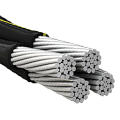
Southern California Edison (SCE) installed triple-insulated ACSR (Aluminum Conductor Steel Reinforced) cables after the 2019 Getty Fire. These cables, suspended by steel messenger wires, prevent phase-to-phase contact during winds up to 130 mph. Over five years, spacer cables reduced fire incidents by 85% in high-risk zones.
Table 2: Spacer Cable Performance
| Metric | Standard ACSR | Insulated Spacer Cable |
|---|---|---|
| Wind Resistance | 90 mph | 130 mph |
| Fire Risk Reduction | 0% | 85% |
| Installation Cost/Mile | $500,000 | $750,000 |
| Source: SCE Wildfire Mitigation Report, 2023 |
Portable Substations: Powering Critical Infrastructure
Siemens’ Sivacon S8 portable substation delivers 72 MVA of temporary power, enough for 20,000 homes. After Iowa’s 2023 derecho, 10 units restored electricity to 50,000 households in 48 hours. Each substation fits on two flatbed trucks and deploys in eight hours, featuring gas-insulated switchgear to prevent fire hazards.
5. Specialized Teams: Training, Tools, and Tactics
Storm Response Units: Precision Under Pressure
Florida Power & Light’s (FPL) 13,000-member storm team includes certified arborists, drone pilots, and lineworkers. Pre-staging equipment in strategic hubs, FPL restored power to 2.1 million customers within 48 hours after Hurricane Ian. Crews use predictive analytics to stockpile aluminum conductors, insulators, and reclosers based on storm paths.
Wildfire Mitigation Squads: Preventing Disasters Before They Strike
PG&E’s Rapid Incident Prevention Teams patrol California’s high-risk zones with Texas A&M’s Distribution Fault Anticipation (DFA) system. The DFA detects micro-arcing—a precursor to wildfires—by analyzing current harmonics. In 2024, it identified 12 potential fires, including a corroded clamp in the Sam Houston National Forest. Repairs took six hours, averting a 10,000-acre blaze.
6. Case Studies: Lessons from the Field
Case 1: Nepal’s Earthquake Recovery
A 7.8-magnitude earthquake in 2025 collapsed 80% of Nepal’s grid. DNV’s Smart Towers restored Kathmandu’s hospitals within 18 hours, using helicopter-dropped modules in remote areas. The $2.5 million project prevented a public health crisis, showcasing the ROI of modular infrastructure.
Case 2: AI Averts a Texas Wildfire
MidSouth Electric Cooperative integrated Texas A&M’s DFA system into its SCADA network. In 2024, the AI flagged a deteriorating clamp on a 138 kV aluminum line. Crews replaced it during a scheduled outage, avoiding a wildfire predicted to burn 10,000 acres. The 15,000repairsavedanestimated15,000repairsavedanestimated200 million in damages.
7. Innovations Shaping the Future of Disaster Response
Machine Learning: Predicting Failures Before They Occur
The U.S. Department of Energy’s GRIP (Grid Resilience and Intelligence Project) uses neural networks to predict equipment failures. Trained on 10 TB of historical data, the AI identifies corrosion patterns in aluminum conductors with 95% accuracy. Utilities like Duke Energy now replace 50% fewer components preemptively, cutting costs by 30%.
Self-Healing Grids: The Dawn of Autonomous Recovery
ABB’s Microgrid Plus system isolates faults in 30 milliseconds, rerouting power via redundant aluminum lines. In a Swedish pilot, the technology reduced outage durations by 60%, ensuring uninterrupted supply to 5,000 homes during a 2023 snowstorm.
8. Conclusion
Disasters test the limits of aluminum overhead lines, but they also unveil humanity’s capacity for innovation. From drone swarms mapping devastation to AI predicting tomorrow’s faults, the tools exist to transform recovery from a desperate sprint into a strategic victory. As grids evolve, so too does our resolve—to rebuild faster, smarter, and stronger.
9. References
- DNV. Emergency Restoration System Field Trials. 2023.
- Texas A&M Engineering. Distribution Fault Anticipation for Wildfire Prevention. 2024.
- U.S. Department of Energy. Grid Resilience and Intelligence Project (GRIP). 2023.
- Southern California Edison. Wildfire Mitigation and Spacer Cable Performance. 2023.
- Siemens. Portable Substations in Disaster Response. 2024.
- IEEE. AI Applications in Power Grid Restoration. 2024.

No comment