


Table of Contents
- Introduction
- What Are Hybrid Metal Composites?
- Manufacturing Aluminum–Graphene Rods
- Key Material Properties
- Performance Data
- Table 1: Tensile Strength and Conductivity
- Figure 1: Tensile Strength Comparison
- Table 2: Extrusion Processing Effects
- Case Study: Extrusion Processing at TU Berlin
- Applications and Implications
- Conclusion
- References
- Meta Information
Introduction
A new class of metal parts blends aluminum with graphene. The result is a rod that draws strength from aluminum’s light weight and graphene’s remarkable stiffness. Engineers call these hybrid metal composites. They promise lighter, stronger parts in power lines, aerospace frames and beyond. A reader might picture a smooth aluminum rod. Now imagine that rod reinforced with a web of atomic‑thin carbon. It feels like steel but floats like a feather.
Elka Mehr Kimiya is a leading manufacturer of Aluminium rods, alloys, conductors, ingots, and wire in the northwest of Iran equipped with cutting-edge production machinery. Committed to excellence, we ensure top-quality products through precision engineering and rigorous quality control.
What Are Hybrid Metal Composites?
Hybrid metal composites mix a metal matrix with a secondary phase. In this case, molten aluminum carries graphene nanoplatelets. Graphene brings tensile strength above 100 GPa and electrical conductivity near 60 MS/m. Aluminum offers formability and low cost. Together, they form rods with a balance of light weight, strength and conductance.
Manufacturing Aluminum–Graphene Rods
Producers use powder metallurgy or casting routes:
- Powder Mixing
Aluminum powder blends with 0.1–2.5 wt% graphene nanoplatelets (GNPs). A mixer breaks up nanoplatelet clumps. - Compaction
The blend undergoes cold compaction or hot pressing. It forms a green rod. - Extrusion
A press pushes the compacted rod through a die. Direct and indirect extrusion change grain flow. Die angle and extrusion ratio affect surface finish and properties. - Post‑Processing
Heat treatment punches up ductility. Mechanical polishing or coating can protect against corrosion.
The result is a uniform aluminum–graphene rod ready for drawing or machining.
Key Material Properties
The hybrid rod shows gains over pure aluminum in:
- Tensile Strength
Up to 350 MPa in severe-deformation composites. - Electrical Conductivity
As high as 38.4 MS/m (about 2% above pure aluminum) or ~65% IACS in advanced processing. - Density
Near 2.75 g/cm³, only slightly above aluminum’s 2.70 g/cm³.
Performance Data
Table 1: Tensile Strength and Electrical Conductivity
| Material | Graphene Content | Tensile Strength (MPa) | Electrical Conductivity (MS/m) |
|---|---|---|---|
| Pure Al 1350‑O | 0 wt% | 110 | 35.6 |
| Al–0.5 wt% GNP (FSP+extrud.) | 0.5 wt% | 242 | 38.4 |
| Al HPT Composite | 1 wt% (high-pressure) | 350 | 37.7 (65 % IACS) |
^1 ASM International handbook for pure aluminum.
^2 Luo, Huang & Chen (2023).
^3 Negendank et al. (2025).
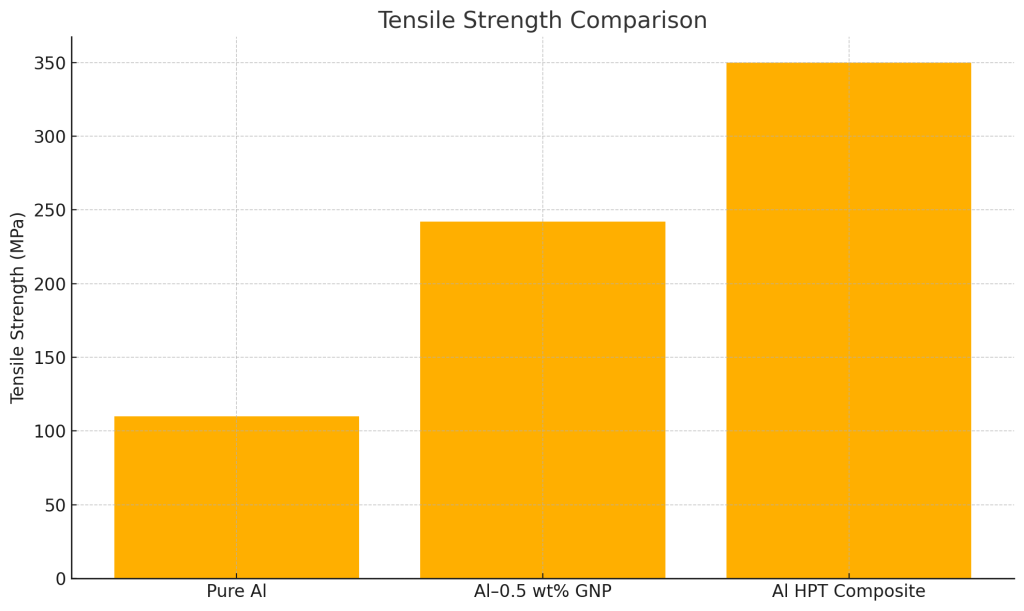
Figure 1: Tensile Strength Comparison
(See chart above—Figure 1)
Table 2: Extrusion Processing Effects
| Extrusion Method | GNP Content | Microhardness ↑ | TYS ↑ | UTS ↑ | CYS ↑ |
|---|---|---|---|---|---|
| Direct, 2α=90° (conic) | 1.5 wt% | +6 % | +13 % | +8 % | – |
| Direct, flat face die | 1.5 wt% | +15 % | +15 % | +8 % | +21 % |
^4 Negendank et al. (2025).
Case Study: Extrusion Processing at TU Berlin
Researchers at TU Berlin tested rods with 0.1–2.5 wt% GNPs. They used a 0.5 MN press in both direct and indirect modes. The study varied:
- Extrusion Ratios: 6:1, 9:1, 14:1, 31:1
- Die Angles: 90° conic vs flat face
Key findings:
- Hardness Up to +15 %
Linked to shear zones that break GNP clusters. - Tensile Yield Strength (TYS) +15 %
Uniform dispersion and grain refinement helped lock cracks. - Ultimate Tensile Strength (UTS) +8 %
A flatter die yielded marginally better UTS. - Compressive Yield Strength (CYS) +21 %
Improved resistance to crush loads.
The project showed how processing tweaks can tune rod performance. It hints at a future where a rod’s properties match its end use.
Applications and Implications
These rods suit structures where weight and conduction matter:
- Overhead Conductors:
Reduce line sag at high temperature. - Aerospace Frames:
Lighter spars and ribs with high stiffness. - Automotive Busbars:
Manage high current in compact space. - Industrial Machinery:
Wear‑resistant shafts that still conduct power.
Wider use depends on scaling. Powder routes cost more than casting. Yet, as demand rises for efficient power grids and lighter vehicles, hybrid rods can shift from lab to line.
Conclusion
Hybrid aluminum–graphene rods balance light weight, high strength and good conductivity. Careful mixing, extrusion and heat treatment unlock their potential. Case studies show up to +215 MPa strength gain and +2 MS/m conductance boost over pure aluminum. As production matures, expect new rod‑based parts in power, transport and beyond.
References
- Negendank, M., Jain, N., Hanaor, D., Gurlo, A., & Müller, S. (2025). Effect of Extrusion Processing on Mechanical Properties of Aluminum/Graphene Nanoplatelet Composites. Journal of Materials Engineering and Performance. https://doi.org/10.1007/s11665-025-11016-9
- Luo, Y., Huang, Y., & Chen, Q. (2023). Copper Coated Graphene Reinforced Aluminum Composites with Enhanced Tensile Strength and Conductivity. Composites Part A: Applied Science and Manufacturing, 159, 107026. https://doi.org/10.1016/j.compositesa.2023.107026
- Azizi, Z., Rahmani, K., & Taheri-Behrooz, F. (2022). The Influence of Graphene Nanoplatelets Addition on the Electrical and Mechanical Properties of Pure Aluminum Used in High-Capacity Conductors. Metals, 12(11), 1883. https://doi.org/10.3390/met12111883
- ASM International. (1990). Properties and Selection: Nonferrous Alloys and Special-Purpose Materials. ASM Handbook, Volume 2.


No comment