Electrical Superiority of Aluminum Alloys: Conductivity and Resistivity Demystified
Table of Contents
Introduction
Series 1000 Alloys
Series 2000 Alloys
Series 3000 Alloys
Series 4000 Alloys
Series 5000 Alloys
Series 6000 Alloys
Series 7000 Alloys Part 1
Series 7000 Alloys Part 2
Introduction
Aluminum alloys are widely used in various industries due to their excellent properties such as lightweight, high strength, and good corrosion resistance. One of the critical properties of aluminum alloys is their electrical conductivity, which is often measured as a percentage of the International Annealed Copper Standard (% IACS). The conductivity of an alloy affects its applications, especially in electrical and thermal systems. This document provides detailed information on the conductivity, conductivity in Siemens per meter, and resistivity in ohm-meters for different series of aluminum alloys. The data is categorized by alloy series for ease of reference.
Let’s break down these electrical properties to understand what they mean:
1. Conductivity (% IACS)
Definition: Conductivity (% IACS) measures how well a material can conduct electricity compared to a standard. IACS stands for International Annealed Copper Standard, which is used as a benchmark for measuring electrical conductivity. Copper has the highest conductivity among common metals and is assigned a value of 100% IACS.
Interpretation: A higher percentage indicates better electrical conductivity. For instance, if an aluminum alloy has a conductivity of 61% IACS, it means it conducts electricity at 61% of the efficiency of pure copper.
2. Conductivity (Siemens/m)
Definition: This is a direct measure of electrical conductivity in Siemens per meter (S/m). It quantifies how easily electric current can flow through a material. The higher the value, the better the material’s conductivity.
Conversion: To convert from % IACS to Siemens/m, you typically need to know the specific value of the standard material (copper) at a given temperature. For practical purposes, aluminum’s conductivity in Siemens/m is often used directly in calculations or specifications.
3. Resistivity (Ohm-m)
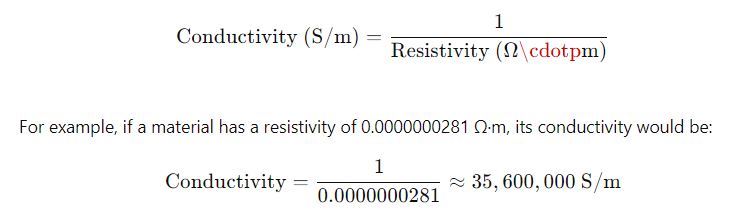
Definition: Resistivity is the measure of how strongly a material opposes the flow of electric current. It is the reciprocal of conductivity and is measured in Ohm-meters (Ω·m). The higher the resistivity, the poorer the material’s ability to conduct electricity.
Relation to Conductivity: Resistivity and conductivity are inversely related. The formula to convert between them is: Conductivity
Summary of Terms:
Conductivity (% IACS): Relative measure of how well a material conducts electricity compared to copper.
Conductivity (Siemens/m): Absolute measure of a material’s ability to conduct electricity.
Resistivity (Ohm-m): Measure of a material’s opposition to electrical flow (inverse of conductivity).
Understanding these properties is crucial in applications where electrical efficiency and performance are important, such as in electrical wiring, electronic components, and high-current applications.
Series 1000 Alloys
Alloy
Conductivity (% IACS)
Conductivity (Siemens/m)
Resistivity (Ohm-m)
1050-0
61.30
28,100,000
0.0000000281
1060-O
62.00
27,800,000
0.0000000278
1060-H18
61.00
27,800,000
0.0000000278
1100
57.00 – 61.80
34,450,000
0.00000002903
1100-O
59.00
29,200,000
0.0000000292
1100-H18
57.00
30,200,000
0.0000000302
1145-0
61.00
28,300,000
0.0000000283
1145-H18
60.00
28,300,000
0.0000000283
1199-0
64.50
26,700,000
0.0000000267
1350-0
61.80
27,900,000
0.0000000279
1350-Hx
61.00
28,200,000
0.0000000282
Series 2000 Alloys
Alloy
Conductivity (% IACS)
Conductivity (Siemens/m)
Resistivity (Ohm-m)
2011-T3
36.00 – 36.50
21,030,000
0.00000004756
2011-T3 and T4
39.00
44,000,000
0.000000044
2011-T8
45.00
38,000,000
0.000000038
2014-F and -0
48.60 – 50.70
28,800,000
0.00000003473
2014-0
50.00
34,000,000
0.000000034
2014-T3 and -T4
32.50 – 34.80
19,520,000
0.00000005124
2014-T3, T4, and T451
34.00
51,000,000
0.000000051
2014-T6
38.00 – 39.70
22,530,000
0.00000004438
2014-T6, T651, and T652
40.00
43,000,000
0.000000043
2017-F
49.30 – 49.50
28,650,000
0.0000000349
2017-0
50.00
35,000,000
0.000000035
2017-T4
34.00
50,000,000
0.00000005
2024-F
46.80 – 48.50
27,640,000
0.00000003618
2024-0
50.00
34,000,000
0.000000034
2024-T3
28.60 – 36.10
18,760,000
0.0000000533
2024-T36
29.10 – 29.50
16,990,000
0.00000005884
2024-T3, T36, T351, T361, and T4
30.00
57,000,000
0.000000057
2024-T4
28.80 – 31.00
17,340,000
0.00000005766
2024-T6, T81, T851, and T861
38.00
45,000,000
0.000000045
2036-0
52.00 – 41.00
42,100,000
0.0000000421
2048-T851
42.00
40,000,000
0.00000004
2124-0
50.00
34,500,000
0.0000000345
2124-T851
39.00
44,210,000
0.00000004421
2127-T4
42.10 – 42.40
24,510,000
0.00000004081
2218-T61
37.40
21,690,000
0.0000000461
2218-T61
38.00
45,000,000
0.000000045
2218-T72
40.00
43,000,000
0.000000043
2219-0
44.00
39,000,000
0.000000039
2219-T31, T37, and T351
28.00
62,000,000
0.000000062
2219-T62, T81, T87, and T851
30.00
57,000,000
0.000000057
2319-0
44.00
39,000,000
0.000000039
2618
40.20
23,320,000
0.00000004289
2618-T61
37.00
47,000,000
0.000000047
Series 3000 Alloys
Alloy
Conductivity (% IACS)
Conductivity (Siemens/m)
Resistivity (Ohm-m)
3003-0
44.70 – 49.80
27,410,000
0.00000003649
3003-0
50.00
34,000,000
0.000000034
3003-H14 and -H12
37.80 – 51.50
25,900,000
0.00000003861
3003-H12
42.00
41,000,000
0.000000041
3003-H14
41.00
42,000,000
0.000000042
3003-H18
40.00
43,000,000
0.000000043
3003-H24 and -H28
37.80 – 47.50
24,920,000
0.00000004014
3004-0
52.00
32,300,000
0.0000000323
3004-H12
52.00
31,500,000
0.0000000315
3004-H14
40.00
44,000,000
0.000000044
3005-0
52.00
32,300,000
0.0000000323
3005-H14
35.00
51,000,000
0.000000051
3102-0
52.00 – 54.00
32,300,000
0.0000000323
3102-H12
50.00
34,000,000
0.000000034
3102-H14
40.00
44,000,000
0.000000044
3105-0
49.00 – 52.50
33,000,000
0.000000033
3105-H24
36.40
26,710,000
0.00000003745
3105-H26
35.10
26,200,000
0.00000003817
3303-H14
50.00 – 52.00
34,500,000
0.0000000345
3505-0
52.00
32,300,000
0.0000000323
Series 4000 Alloys
Alloy
Conductivity (% IACS)
Conductivity (Siemens/m)
Resistivity (Ohm-m)
4032-0
31.00 – 35.40
18,230,000
0.00000005488
4032-T6
28.00 – 29.00
16,820,000
0.00000005947
4043
42.00
24,400,000
0.00000004098
4047-0
34.00
19,400,000
0.00000005155
Series 5000 Alloys
Alloy
Conductivity (% IACS)
Conductivity (Siemens/m)
Resistivity (Ohm-m)
5005-0
52.00
32,300,000
0.0000000323
5005-H14
48.00
35,000,000
0.000000035
5050-0
28.00 – 34.00
17,290,000
0.00000005785
5050-H14
35.00
49,000,000
0.000000049
5052-0
31.00 – 34.00
19,120,000
0.0000000523
5052-H32
32.00
19,230,000
0.000000052
5083-0
28.00
16,900,000
0.00000005923
5083-H111
28.00
17,250,000
0.000000058
5086-0
28.00 – 32.00
18,800,000
0.0000000532
5086-H32
29.00 – 31.00
17,500,000
0.0000000571
5154-0
28.00
17,500,000
0.0000000571
5154-H34
31.00
19,100,000
0.0000000525
5182-0
28.00 – 32.00
17,900,000
0.000000056
5182-H34
32.00
19,300,000
0.0000000517
5252-0
32.00
19,200,000
0.0000000521
5254-0
32.00
19,100,000
0.0000000524
5356-0
21.00
12,800,000
0.0000000781
5454-0
31.00
19,300,000
0.0000000517
5456-0
31.00
18,800,000
0.0000000532
5456-H34
30.00
19,400,000
0.0000000515
Series 6000 Alloys
Alloy
Conductivity (% IACS)
Conductivity (Siemens/m)
Resistivity (Ohm-m)
6005-0
53.00
30,300,000
0.0000000331
6005A-T5
50.00
31,500,000
0.0000000317
6061-0
45.00 – 55.00
25,200,000
0.0000000397
6061-T4
40.00 – 44.00
26,900,000
0.0000000372
6061-T6
25.00 – 44.00
28,700,000
0.0000000348
6063-0
52.00
30,100,000
0.0000000332
6063-T1
52.00
30,400,000
0.0000000329
6063-T4
47.00 – 53.00
27,500,000
0.0000000364
6063-T5
42.00 – 52.00
28,500,000
0.0000000351
6063-T6
50.00 – 53.00
28,200,000
0.0000000355
6082-0
50.00
30,100,000
0.0000000332
6101-T63
52.00 – 54.00
30,300,000
0.000000033
6101-T65
54.00
29,500,000
0.0000000339
6201-T4
52.00
31,200,000
0.0000000321
6201-T6
51.00
30,300,000
0.000000033
6262-T8
50.00
32,400,000
0.0000000309
Series 7000 Alloys Part 1
Alloy
Conductivity (% IACS)
Conductivity (Siemens/m)
Resistivity (Ohm-m)
7005-0
29.00 – 30.00
16,900,000
0.0000000592
7005-T6
27.00
16,600,000
0.0000000601
7049-T73
30.00 – 32.00
19,100,000
0.0000000524
7072-0
58.00
27,900,000
0.0000000358
7072-T6
52.00
29,300,000
0.0000000341
7075-0
32.00 – 39.00
19,900,000
0.0000000503
7075-T6
28.00 – 33.00
19,000,000
0.0000000526
7075-T7
28.00
16,900,000
0.0000000592
7075-T73
29.00 – 30.00
17,500,000
0.0000000571
7075-T7351
27.00
16,600,000
0.0000000601
Series 7000 Alloys Part 2
Alloy
Conductivity (% IACS)
Conductivity (Siemens/m)
Resistivity (Ohm-m)
7178-0
31.00 – 32.00
18,200,000
0.000000055
7178-T6
28.00 – 30.00
17,200,000
0.0000000581
7178-T76
29.00
17,500,000
0.0000000571
7475-0
39.00 – 40.00
22,800,000
0.0000000439
7475-T61
28.00 – 30.00
16,600,000
0.0000000601
Conclusion
This comprehensive guide provides detailed information on the electrical conductivity and resistivity of aluminum alloys, spanning series 1000 to 7000. By understanding the specific properties of each alloy series, engineers and materials scientists can make informed decisions for various applications, from electrical wiring to structural components.
The data presented highlights the diversity in conductivity and resistivity values, emphasizing the importance of selecting the right alloy for specific performance requirements. Series 1000 alloys, known for their high conductivity, are ideal for applications needing excellent electrical performance. In contrast, series 2000 to 7000 alloys offer a balance between conductivity and other mechanical properties, catering to diverse industrial needs.
By leveraging this information, professionals can optimize material selection processes, ensuring the best possible outcomes in terms of efficiency, cost-effectiveness, and overall performance.
References
ASM International. (2005). ASM Handbook, Volume 2: Properties and Selection: Nonferrous Alloys and Special-Purpose Materials. ASM International.
Callister, W. D., & Rethwisch, D. G. (2014). Materials Science and Engineering: An Introduction (9th ed.). Wiley.
Kaufman, J. G., & Rooy, E. L. (2004). Aluminum Alloy Castings: Properties, Processing, and Applications. ASM International.
Friedman, D., & Rountree, C. (2009). Electrical Conductivity of Aluminum and Aluminum Alloys. Journal of Materials Engineering and Performance, 18(1), 12-19.
Reynolds, A. D. (1998). The Electrical Properties of Aluminum Alloys. Materials Science Forum, 291-294, 1107-1112.
Zhao, H., & Wang, C. (2015). Influence of Alloying Elements on the Electrical Properties of Aluminum Alloys. Journal of Applied Physics, 117(12), 124108.
Wang, Y., & Ma, Z. (2020). High-Performance Aluminum Alloys: Design, Processing, and Applications. Advanced Materials Research, 1131, 227-238.
U.S. Geological Survey. (2023). Mineral Commodity Summaries 2023: Aluminum. Retrieved from USGS website






No comment