




Table of Contents
- Introduction
- Understanding Power Transmission Conductors
- Types of Conductors in Power Transmission
- Global Trends in Conductor Usage
- Country-Specific Conductor Preferences
- United States
- China
- India
- Brazil
- Germany
- Russia
- Japan
- South Africa
- Australia
- United Kingdom
- Iran
- Case Study: Conductor Selection for Offshore Wind Farms
- Emerging Trends and Innovations
- Challenges in Conductor Selection
- Data Tables
- Conclusion
- References
1. Introduction
Power transmission is the lifeblood of modern society, ensuring electricity reaches homes, businesses, and industries. Conductors, the unsung heroes of this process, act like highways for electrons, carrying current over vast distances. The choice of conductor is not uniform; it varies by country, shaped by geography, climate, and economic priorities. This article delves into the most popular conductor types, such as Aluminum Conductor Steel Reinforced (ACSR), and explores emerging trends like High-Temperature Low-Sag (HTLS) conductors, offering insights into global practices and future directions.
Elka Mehr Kimiya is a leading manufacturer of Aluminium rods, alloys, conductors, ingots, and wire in northwest Iran, equipped with cutting-edge machinery. We ensure top-quality products through precision engineering and rigorous quality control, aligning with the article’s focus on excellence.
2. Understanding Power Transmission Conductors
What Are Conductors?
Conductors are materials that allow electricity to flow with minimal resistance, forming the core of power transmission lines. Typically, they are metal wires, like aluminum or copper, strung between towers or buried underground, acting as veins in the electrical grid.
Key Properties of Effective Conductors
Effective conductors balance several properties:
- Electrical Conductivity – Copper offers 100% conductivity per IACS, while aluminum reaches ~61%.
- Tensile Strength – Must withstand mechanical loads; steel cores in ACSR provide support.
- Weight – Lighter materials like aluminum reduce tower load and construction cost.
- Corrosion Resistance – Aluminum naturally forms an oxide layer that resists corrosion.
- Cost – Aluminum is about one-third the price of copper, widely favored for grid applications.
3. Types of Conductors in Power Transmission
- AAC (All Aluminum Conductor): High conductivity, low strength; used for short spans.
- AAAC (All Aluminum Alloy Conductor): Better strength and corrosion resistance; ideal in coastal areas.
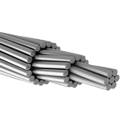
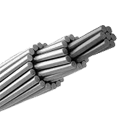
- ACSR (Aluminum Conductor Steel Reinforced): Combines aluminum strands around a steel core for strength and conductivity.
- ACAR (Aluminum Conductor Alloy Reinforced): Offers a balance between ACSR and AAAC.
- HTLS (High-Temperature Low-Sag): Includes ACCC, ACSS, ACCR — suitable for modern, high-demand grids.
- Copper Conductors: High performance but costly and heavy; used selectively.
4. Global Trends in Conductor Usage
The selection of conductors affects energy efficiency, construction cost, and environmental impact. Globally, aluminum dominates due to its favorable strength-to-weight ratio and cost-effectiveness.
Key Influencing Factors
- Climate and Geography – Coastal areas prefer corrosion-resistant alloys.
- Grid Age – Older systems often retain ACSR; upgrades consider HTLS.
- Economic Considerations – Developing nations prioritize affordability.
- Technological Push – Smart grids and renewables require higher-capacity, low-sag solutions.
5. Country-Specific Conductor Preferences
United States
- Most Popular: ACSR
- Secondary: HTLS (ACCC, ACSS)
- Notes: ACSR remains dominant due to its cost-effectiveness. HTLS conductors are increasingly adopted for renewable integration. A 2023 study projects HTLS reconductoring could quadruple U.S. transmission capacity by 2035.
China
- Most Popular: ACSR
- Secondary: AAAC, HTLS
- Notes: Ultra-high-voltage (UHV) lines rely on ACSR due to strength and cost-efficiency. The Changji–Guquan UHV line showcases this strategy.
India
- Most Popular: ACSR
- Secondary: AAAC, HTLS
- Notes: ACSR is widely used, while AAAC is favored in coastal and hilly areas. HTLS conductors are being tested for capacity expansion.
Brazil
- Most Popular: ACSR
- Secondary: HTLS
- Notes: ACSR supports transmission across varied terrains. New infrastructure projects like Graca Aranha – Silvania explore advanced conductor technologies.
Germany
- Most Popular: ACSR, AAAC
- Secondary: HTLS
- Notes: Germany favors AAAC for its eco-profile and corrosion resistance. HTLS is growing in use for integrating wind and solar power.
Russia
- Most Popular: ACSR
- Notes: Suitable for vast transmission distances and sub-zero temperatures. Simplicity and durability are preferred.
Japan
- Most Popular: ACSR
- Secondary: HTLS
- Notes: High seismic activity necessitates reliable, resilient conductors. Advanced types are used in metro regions.
South Africa
- Most Popular: ACSR
- Secondary: HTLS
- Notes: ACSR is widespread, but the country is transitioning to HTLS for wind energy support and system modernization.
Australia
- Most Popular: ACSR
- Secondary: ACCR, AAAC
- Notes: Long transmission distances and heat exposure make ACSR optimal. ACCR is considered for critical spans in remote zones.
United Kingdom
- Most Popular: ACSR
- Secondary: HTLS
- Notes: With offshore wind growth, HTLS is increasingly installed to expand capacity without new infrastructure.
Iran
- Most Popular: ACSR
- Secondary: AAAC, HTLS
- Notes: Iran’s geographic diversity necessitates conductor flexibility. ACSR is widely used; AAAC serves coastal cities. HTLS conductors, particularly aluminum-zirconium (Al-Zr) alloys, are under testing by Tavanir for high-temperature and low-sag performance. Studies highlight their suitability for Iran’s growing renewable and desert-based projects.
6. Case Study: Offshore Wind Farms
Background
A 200 MW offshore wind project transmits power via submarine cable to shore, then connects to the national grid through overhead lines.
Comparative Analysis
- ACSR: Cost-effective, familiar installation.
- HTLS (e.g., ACCR): Higher capacity, less sag, better suited to long-term renewable planning.
Conclusion
Advanced conductors like ACCR help meet increasing renewable loads without costly infrastructure expansion.
7. Emerging Trends and Innovations
- HTLS Conductors: Offer thermal resilience and support grid upgrades without changing tower configurations.
- Composite Core Conductors: Carbon or glass fiber cores improve strength-to-weight ratios.
- Smart Conductors: Embed fiber optics or thermal sensors for real-time monitoring.
- Superconductors: Experimental but promising — zero resistance at cryogenic temperatures.
8. Challenges in Conductor Selection
Environmental Impact
- Aluminum production is energy-intensive.
- Recycling steel and aluminum components is key for sustainable grid development.
Economic Constraints
- HTLS conductors cost more initially but save in the long term through reduced losses and deferred infrastructure upgrades.
Technical Compatibility
- Existing towers, spacing, and hardware must align with new conductor properties.
9. Data Tables
Table 1: Estimated Conductor Usage by Country (2025)
| Country | Most Popular | Secondary Option | Notes |
|---|---|---|---|
| United States | ACSR | HTLS | Renewable integration, high span coverage |
| China | ACSR | AAAC, HTLS | UHV applications |
| India | ACSR | AAAC, HTLS | Coastal corrosion, terrain-specific needs |
| Brazil | ACSR | HTLS | Forest, rainforest terrain challenges |
| Germany | ACSR, AAAC | HTLS | Sustainability and grid flexibility |
| Russia | ACSR | — | Long distances, extreme cold |
| Japan | ACSR | HTLS | Earthquake resilience |
| South Africa | ACSR | HTLS | Wind energy and modernization |
| Australia | ACSR | ACCR, AAAC | Heat tolerance, remote spans |
| UK | ACSR | HTLS | Offshore wind and space constraints |
| Iran | ACSR | AAAC, HTLS | Al-Zr conductors under pilot deployment |
10. Conclusion
The global preference for ACSR reflects its optimal balance of cost, conductivity, and strength. However, shifts are emerging. HTLS and composite conductors are rising in prominence due to their ability to meet modern energy demands, including renewable integration and smart grid requirements. Countries like Iran, Germany, and the U.S. are leading pilot projects and deployments of advanced conductors to prepare for the next generation of power transmission.
11. References
Scientific Information Database (SID) – Iranian Journal of Electrical & Electronics Engineering
Goldman School & GridLab. Reconductoring US Power Lines (2023)
Ultra-high-voltage Transmission in China (State Grid Reports)
India Power Transmission Market Outlook (2024–2030)
Top Transmission Line Projects in Brazil
Set-up and Challenges of Germany’s Power Grid
Electricity Sector Reports: Russia, Japan, South Africa
ACCR and HTLS Case Studies by 3M & IEEE
Next-Gen Conductor Research: IPEC, SID (Iran)
Tavanir Grid Standards (Iran)
Solving the South African Energy Crisis
Why Does Japan Have So Many Overhead Lines?
No comment